
Boeing 717-200
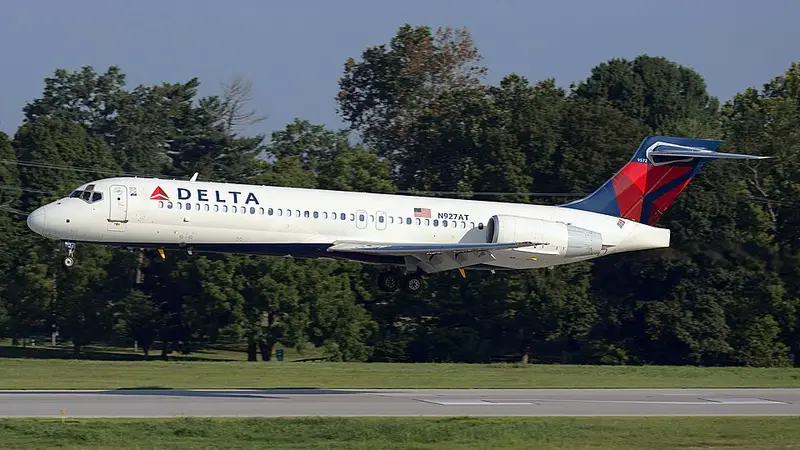
The Boeing 717-200 began life as the McDonnell Douglas MD-95, the final development of the DC-9 lineage, and was renamed after Boeing acquired McDonnell Douglas in 1997. It's a short, twin-engine jet seating around 100 to 130 passengers, aimed at short, high-frequency routes rather than long-haul flying. Its rear-mounted engines and T-tail trace their layout directly back to the original 1965 DC-9, making it one of the longest-running airframe lineages still flying when production ended. Boeing stopped building it in 2006, focusing instead on the 737, leaving the 717 as a comparatively rare type today.

Did you know?
Descended from the 1965 DC-9 via the MD-95, the 717's rear-mounted engines and T-tail trace one of the longest-running airframe lineages still flying.
Specifications
| Length | 37.8 m (124 ft) |
|---|---|
| Wingspan | 28.5 m (93 ft) |
| Height | 8.9 m (29 ft) |
| Maximum passengers | 117 |
| Persons on board | 106-124 |
| Maximum take-off weight | 54.8 t |
| Range | 1,430 NM (2,648 km) |
| Maximum speed | 458 kt (848 km/h) |
| Service ceiling | 37,000 ft (11,278 m) |
| Optimum ceiling | 34,000 ft (10,363 m) |
| Rate of climb | 2,000 ft/min (10.2 m/s) |
| Take-off distance | 2,166 m (7,106 ft) |
| Landing distance | 1,670 m (5,479 ft) |
| Fuel capacity | 18,100 l |
| Engines | 2x Rolls-Royce BR715 |
| Units built | 156 |
Curated by CatchFlights from manufacturer documents, ICAO Doc 8643 and reference works; values are left out where no source could confirm them. Sources are listed on our credits page.
In CatchFlights
In CatchFlights the Boeing 717-200 starts as a Very rare catch. The tier is an editorial judgement of how special a sighting of this type is. The more often you catch it, the closer it moves to Common for you.
A catch counts for the manufacturer Boeing, the 717 family and the model in your collection, and the daily Type Rating quiz asks about the types of each family.
Catch it yourself.CatchFlights shows the aircraft flying near you on a radar, so a type like this one is only a catch away when it passes overhead. Explore CatchFlights.
Browse all aircraft types, or learn to tell Airbus from Boeing.