
Aero (1) Commander 500
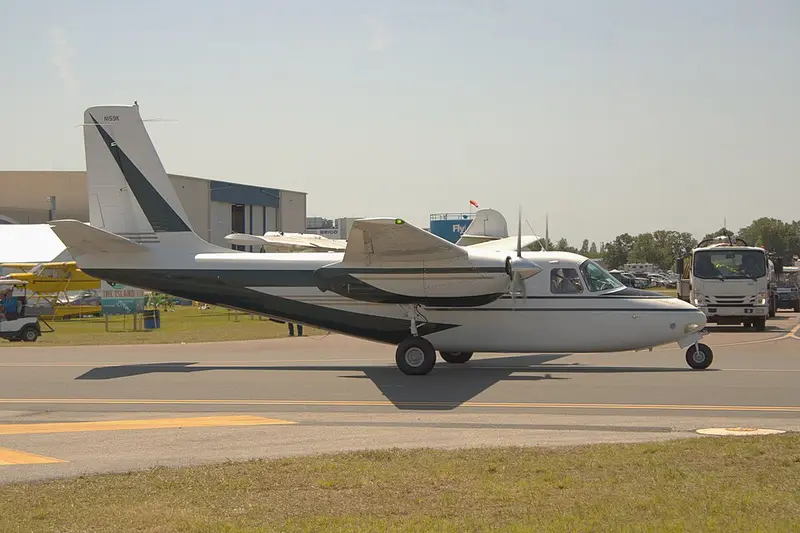
The Commander 500 was the entry-level member of Ted Smith's Aero Commander twin family, introduced in 1958 as a structurally similar but lower-powered version of the Commander 560. Where its stablemates used geared, supercharged engines for high-altitude cruise speed, the 500 traded some of that performance for lower operating cost, aimed at buyers who wanted the type's distinctive high-wing, twin-tail silhouette without the larger models' fuel bills. It shares the family's raised cockpit and clean, all-metal airframe that let 1950s Aero Commanders outrun many contemporary single-engine aircraft despite carrying two engines and a full cabin.
_(4-10-2024).jpg)
Did you know?
The Commander 500 carries the family's trademark high-wing, twin-tail silhouette — the entry-level, cheaper-to-run member of Ted Smith's Commander line.
Specifications
| Length | 11.2 m (37 ft) |
|---|---|
| Wingspan | 14.9 m (49 ft) |
| Height | 4.4 m (14 ft) |
| Persons on board | 6 |
| Maximum take-off weight | 3 t |
| Range | 1,030 NM (1,908 km) |
| Service ceiling | 19,000 ft (5,791 m) |
| Optimum ceiling | 15,000 ft (4,572 m) |
| Rate of climb | 1,340 ft/min (6.8 m/s) |
| Take-off distance | 590 m (1,936 ft) |
| Landing distance | 690 m (2,264 ft) |
| Fuel capacity | 650 l |
Curated by CatchFlights from manufacturer documents, ICAO Doc 8643 and reference works; values are left out where no source could confirm them. Sources are listed on our credits page.
In CatchFlights
In CatchFlights the Aero (1) Commander 500 starts as a Rare catch. The tier is an editorial judgement of how special a sighting of this type is. The more often you catch it, the closer it moves to Common for you.
A catch counts for the manufacturer Aero (1), the Commander 500 family and the model in your collection, and the daily Type Rating quiz asks about the types of each family.
Catch it yourself.CatchFlights shows the aircraft flying near you on a radar, so a type like this one is only a catch away when it passes overhead. Explore CatchFlights.
Browse all aircraft types, or learn to tell Airbus from Boeing.