
Piaggio P-180 Avanti
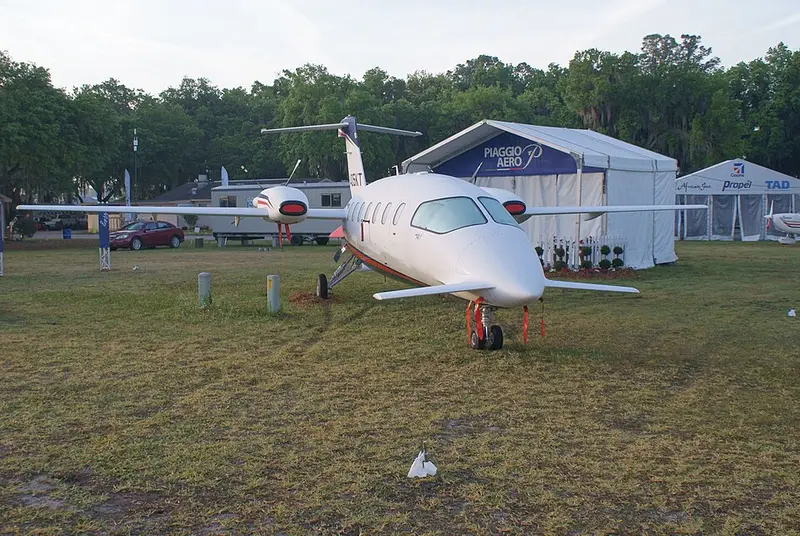
The Piaggio P.180 Avanti has one of the most unusual layouts of any business aircraft: a small forward canard wing, a conventional main wing set unusually far back on the fuselage, and rear-mounted pusher propellers, giving it three separate lifting surfaces instead of the usual two. That layout, combined with a very slim, low-drag fuselage, lets it cruise nearly as fast as some small jets while burning significantly less fuel as a turboprop. Its pusher propellers, mounted behind the wing rather than in front, also make for an unusually quiet cabin compared with typical tractor-propeller turboprops. Its striking silhouette makes it one of the most immediately recognisable aircraft in business aviation.
.jpg)
Did you know?
The Avanti entered service in 1990, one of very few three-surface aircraft ever to reach production, giving it handling unlike any conventional twin.
Specifications
| Length | 14.4 m (47 ft) |
|---|---|
| Wingspan | 14 m (46 ft) |
| Height | 4 m (13 ft) |
| Maximum passengers | 9 |
| Persons on board | 9 |
| Maximum take-off weight | 5.2 t |
| Range | 1,590 NM (2,945 km) |
| Maximum speed | 395 kt (732 km/h) |
| Service ceiling | 41,000 ft (12,497 m) |
| Optimum ceiling | 35,000 ft (10,668 m) |
| Rate of climb | 2,950 ft/min (15 m/s) |
| Take-off distance | 994 m (3,261 ft) |
| Landing distance | 880 m (2,887 ft) |
| Fuel capacity | 1,500 l |
| Engines | 2x Pratt & Whitney Canada PT6A-66B |
| Units built | 246 |
Curated by CatchFlights from manufacturer documents, ICAO Doc 8643 and reference works; values are left out where no source could confirm them. Sources are listed on our credits page.
In CatchFlights
In CatchFlights the Piaggio P-180 Avanti starts as a Rare catch. The tier is an editorial judgement of how special a sighting of this type is. The more often you catch it, the closer it moves to Common for you.
A catch counts for the manufacturer Piaggio, the P-180 Avanti family and the model in your collection, and the daily Type Rating quiz asks about the types of each family.
Catch it yourself.CatchFlights shows the aircraft flying near you on a radar, so a type like this one is only a catch away when it passes overhead. Explore CatchFlights.
Browse all aircraft types, or learn to tell Airbus from Boeing.