
Grumman AO-1 Mohawk
The Grumman OV-1 Mohawk was a twin-turboprop battlefield surveillance aircraft designed for the US Army rather than the Air Force. Its side-by-side cockpit, high wing, and large sensor bays supported visual reconnaissance, infrared imaging, and radar mapping. Mohawks flew extensively in Vietnam and became involved in an inter-service dispute because some carried weapons despite the Army’s limited fixed-wing combat role. The aircraft’s unusual combination of propellers and sophisticated sensors made it ahead of its time.
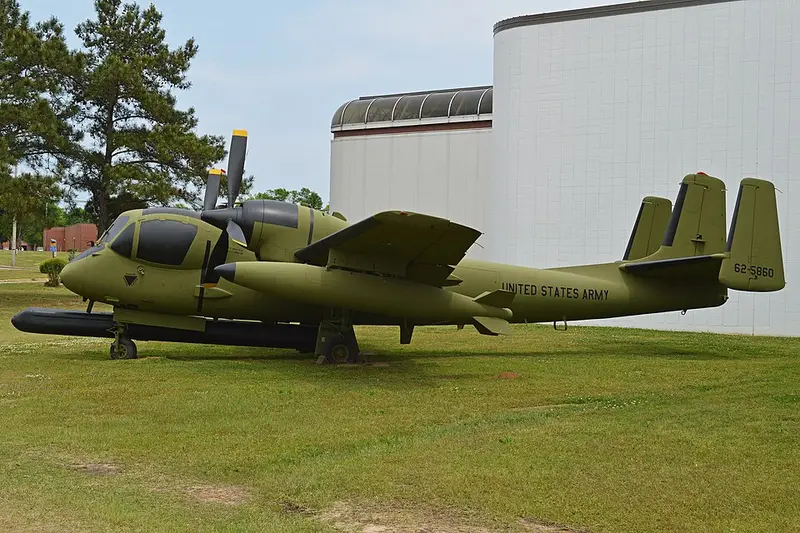
.jpg)
Did you know?
The Grumman OV-1 Mohawk was a twin-turboprop surveillance aircraft built for the US Army rather than the Air Force.
Specifications
| Length | 12.5 m (41 ft) |
|---|---|
| Wingspan | 14.6 m (48 ft) |
| Height | 3.9 m (13 ft) |
| Persons on board | 2 |
| Crew | 2 |
| Maximum take-off weight | 8.2 t |
| Range | 810 NM (1,500 km) |
| Maximum speed | 300 kt (556 km/h) |
| Stall speed | 73 kt (135 km/h) |
| Service ceiling | 25,000 ft (7,620 m) |
| Rate of climb | 3,466 ft/min (17.6 m/s) |
| Take-off distance | 358 m (1,175 ft) |
| Landing distance | 270 m (886 ft) |
| Fuel capacity | 2,300 l |
| Engines | 2x Lycoming T53-L-15 |
| Units built | 380 |
Curated by CatchFlights from manufacturer documents, ICAO Doc 8643 and reference works; values are left out where no source could confirm them. Sources are listed on our credits page.
In CatchFlights
In CatchFlights the Grumman AO-1 Mohawk starts as a Legendary catch. The tier is an editorial judgement of how special a sighting of this type is. The more often you catch it, the closer it moves to Common for you. The first catch of a legendary type pays a bonus of its own.
A catch counts for the manufacturer Grumman, the AO-1 Mohawk family and the model in your collection, and the daily Type Rating quiz asks about the types of each family.
Catch it yourself.CatchFlights shows the aircraft flying near you on a radar, so a type like this one is only a catch away when it passes overhead. Explore CatchFlights.
Browse all aircraft types, or learn to tell Airbus from Boeing.