
Fieseler Fi-156 Storch
Designed by Reinhold Mewes and Erich Bachem to meet a 1935 Luftwaffe requirement for liaison, artillery-spotting and medical evacuation duties, the Fi 156 Storch first flew in 1936 and became famous for its extreme STOL performance, stalling at only about 50 km/h thanks to full-span slats and large flaps. Roughly 2,900 were built by 1945 and it served on every European and North African front, most notably in the 1943 rescue of Benito Mussolini from Gran Sasso. Production continued postwar in France as the Criquet into the 1950s, and the type's long, spindly undercarriage remains a defining silhouette at airshows today.

Did you know?
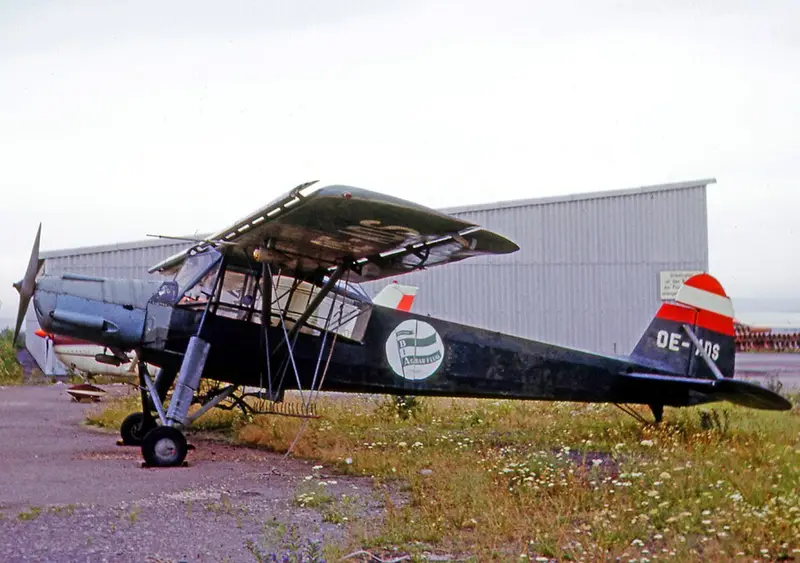
A post-war Czech-built Storch: its slotted wing and long-travel gear let it use strips barely longer than a football pitch.
Specifications
| Length | 9.9 m (32 ft) |
|---|---|
| Wingspan | 14.2 m (47 ft) |
| Height | 3 m (10 ft) |
| Persons on board | 2 |
| Maximum take-off weight | 1.3 t |
| Range | 210 NM (389 km) |
| Service ceiling | 15,000 ft (4,572 m) |
| Rate of climb | 920 ft/min (4.7 m/s) |
Curated by CatchFlights from manufacturer documents, ICAO Doc 8643 and reference works; values are left out where no source could confirm them. Sources are listed on our credits page.
In CatchFlights
In CatchFlights the Fieseler Fi-156 Storch starts as a Legendary catch. The tier is an editorial judgement of how special a sighting of this type is. The more often you catch it, the closer it moves to Common for you. The first catch of a legendary type pays a bonus of its own.
A catch counts for the manufacturer Fieseler, the Fi-156 Storch family and the model in your collection, and the daily Type Rating quiz asks about the types of each family.
Catch it yourself.CatchFlights shows the aircraft flying near you on a radar, so a type like this one is only a catch away when it passes overhead. Explore CatchFlights.
Browse all aircraft types, or learn to tell Airbus from Boeing.