
Douglas DC-9-10
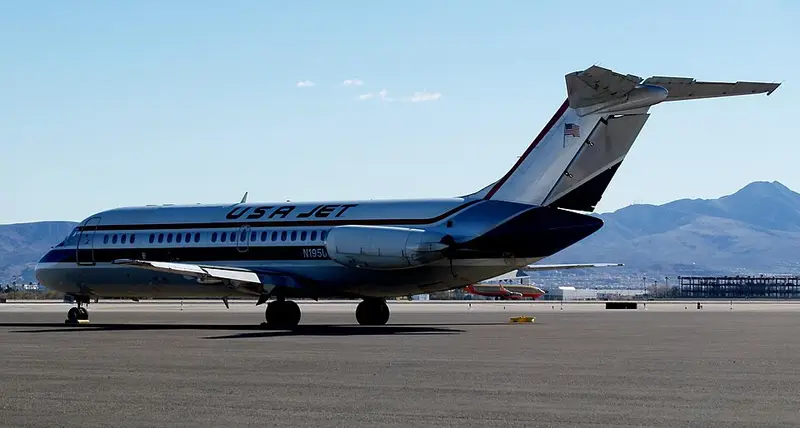
The Douglas DC-9-10 was the original, shortest version of the DC-9 family, one of the first twin-engine, rear-mounted-engine, T-tail jets to enter widespread airline service in the 1960s. That layout, echoed later by the BAC One-Eleven and Fokker F28, kept the cabin quiet and the wing free of engine interference. Its short-field performance and simple systems made it popular with airlines serving smaller cities that couldn't handle larger jets. It set the template for a long line of stretched successors, eventually evolving into the MD-80 and MD-90 families.
.jpg)
Did you know?
The DC-9-10 was among the first rear-engine, T-tail jets, a layout later echoed by the BAC One-Eleven and Fokker F28.
Specifications
| Length | 31.8 m (104 ft) |
|---|---|
| Wingspan | 27.3 m (89 ft) |
| Height | 8.4 m (27 ft) |
| Maximum passengers | 90 |
| Persons on board | 78-105 |
| Maximum take-off weight | 41.1 t |
| Range | 1,400 NM (2,593 km) |
| Maximum speed | 490 kt (907 km/h) |
| Service ceiling | 37,000 ft (11,278 m) |
| Optimum ceiling | 33,000 ft (10,058 m) |
| Rate of climb | 2,800 ft/min (14.2 m/s) |
| Take-off distance | 2,050 m (6,726 ft) |
| Landing distance | 1,415 m (4,642 ft) |
| Fuel capacity | 13,980 l |
| Engines | 2x Pratt & Whitney JT8D-5 |
| Units built | 137 |
Curated by CatchFlights from manufacturer documents, ICAO Doc 8643 and reference works; values are left out where no source could confirm them. Sources are listed on our credits page.
In CatchFlights
In CatchFlights the Douglas DC-9-10 starts as a Legendary catch. The tier is an editorial judgement of how special a sighting of this type is. The more often you catch it, the closer it moves to Common for you. The first catch of a legendary type pays a bonus of its own.
A catch counts for the manufacturer Douglas, the DC-9 family and the model in your collection, and the daily Type Rating quiz asks about the types of each family.
More from the DC-9 family
Catch it yourself.CatchFlights shows the aircraft flying near you on a radar, so a type like this one is only a catch away when it passes overhead. Explore CatchFlights.
Browse all aircraft types, or learn to tell Airbus from Boeing.