
Boeing 707-100
The Boeing 707-100 was the original version of the aircraft that launched the commercial jet age in the West, entering service with Pan Am in 1958 and transforming long-distance air travel almost overnight. Its narrower fuselage and shorter range compared with later 707 variants reflected the limits of early jet engine technology, but it was still dramatically faster than the piston airliners it replaced. Boeing based the 707's fuselage cross-section on its earlier KC-135 military tanker, a shape that went on to define the 737, 757, and every narrow-body Boeing since. Very few original -100s survive today outside museums.
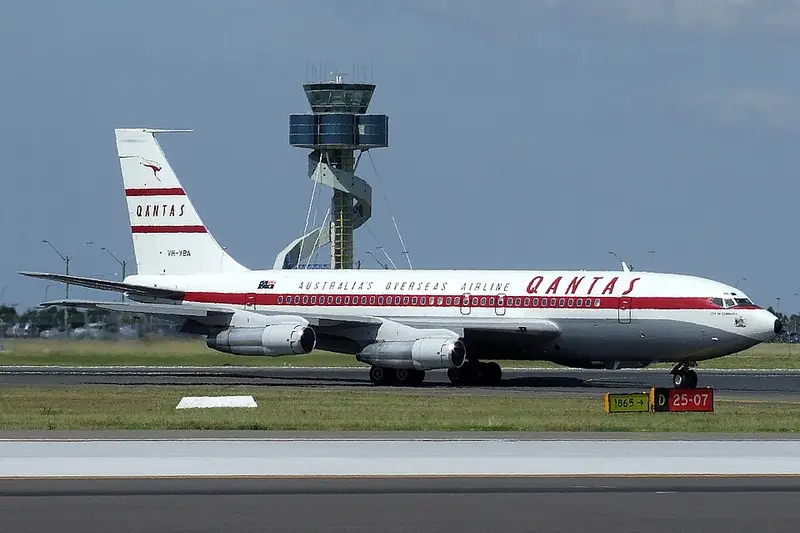
.jpg)
Did you know?
Boeing based the 707's fuselage cross-section on its earlier KC-135 tanker, a shape that later defined the 737 and 757.
Specifications
| Length | 44.2 m (145 ft) |
|---|---|
| Wingspan | 39.9 m (131 ft) |
| Height | 12.7 m (42 ft) |
| Maximum passengers | 137 |
| Persons on board | 110-179 |
| Maximum take-off weight | 116.5 t |
| Range | 3,000 NM (5,556 km) |
| Maximum speed | 490 kt (907 km/h) |
| Service ceiling | 42,000 ft (12,802 m) |
| Optimum ceiling | 33,000 ft (10,058 m) |
| Rate of climb | 3,500 ft/min (17.8 m/s) |
| Take-off distance | 3,000 m (9,843 ft) |
| Landing distance | 1,100 m (3,609 ft) |
| Fuel capacity | 90,000 l |
| Engines | 4x Pratt & Whitney JT3C/JT3D |
Curated by CatchFlights from manufacturer documents, ICAO Doc 8643 and reference works; values are left out where no source could confirm them. Sources are listed on our credits page.
In CatchFlights
In CatchFlights the Boeing 707-100 starts as a Legendary catch. The tier is an editorial judgement of how special a sighting of this type is. The more often you catch it, the closer it moves to Common for you. The first catch of a legendary type pays a bonus of its own.
A catch counts for the manufacturer Boeing, the 707 family and the model in your collection, and the daily Type Rating quiz asks about the types of each family.
More from the 707 family
Catch it yourself.CatchFlights shows the aircraft flying near you on a radar, so a type like this one is only a catch away when it passes overhead. Explore CatchFlights.
Browse all aircraft types, or learn to tell Airbus from Boeing.