
Auster Q
The Auster T.7, Taylorcraft's Model Q, was a dual-control trainer version of the AOP.6 built to teach army pilots the low-level observation flying the type demanded, with 77 delivered. It shared the AOP.6's strengthened fuselage, uprated Gipsy Major 7 engine and fixed aerofoil flaps rather than reverting to a lighter civilian specification. In 1955 two T.7s were specially modified with extra radio gear, enlarged tail surfaces and interchangeable float, ski or wheel undercarriage, repainted bright orange and redesignated Auster Antarctic for the 1956 Commonwealth Trans-Antarctic Expedition. Surplus T.7s, like the AOP.6, later found civilian homes once RAF service ended.
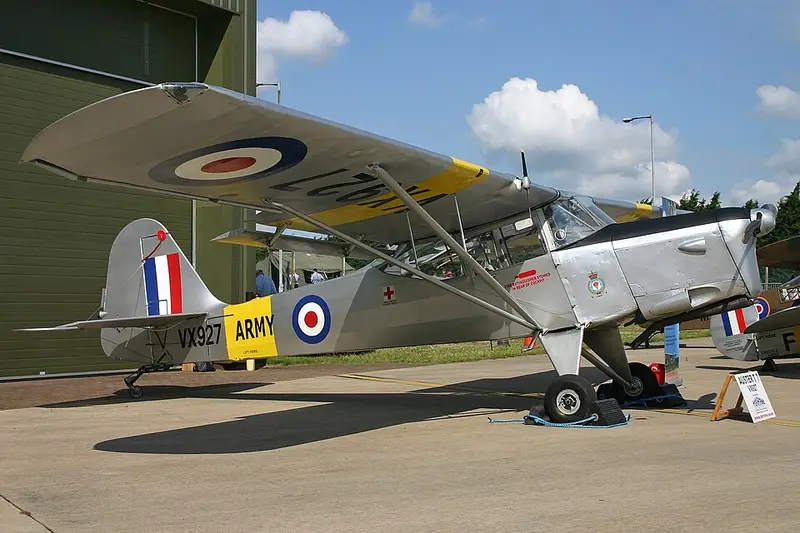
_(6238700438).jpg)
Did you know?
A dual-control trainer built on the AOP.6, the T.7's fame rests on two orange Antarctic conversions that flew in the 1956 Commonwealth Trans-Antarctic Expedition.
Specifications
| Length | 7.2 m (24 ft) |
|---|---|
| Wingspan | 11 m (36 ft) |
| Height | 2.6 m (9 ft) |
| Persons on board | 2 |
| Maximum take-off weight | 1 t |
| Range | 275 NM (509 km) |
| Service ceiling | 14,000 ft (4,267 m) |
| Optimum ceiling | 10,000 ft (3,048 m) |
| Units built | 84 |
Curated by CatchFlights from manufacturer documents, ICAO Doc 8643 and reference works; values are left out where no source could confirm them. Sources are listed on our credits page.
In CatchFlights
In CatchFlights the Auster Q starts as a Rare catch. The tier is an editorial judgement of how special a sighting of this type is. The more often you catch it, the closer it moves to Common for you.
A catch counts for the manufacturer Auster, the Q family and the model in your collection, and the daily Type Rating quiz asks about the types of each family.
Catch it yourself.CatchFlights shows the aircraft flying near you on a radar, so a type like this one is only a catch away when it passes overhead. Explore CatchFlights.
Browse all aircraft types, or learn to tell Airbus from Boeing.