
Saab 2000
The Saab 2000 is a high-speed turboprop regional airliner, built to cruise nearly as fast as some regional jets while retaining a turboprop's fuel efficiency advantage. Its combination of speed and range made it well suited to longer regional routes where a slower conventional turboprop would struggle to stay competitive with jet alternatives on schedule. Despite its performance, it sold in relatively small numbers, arriving at a time when airlines were increasingly favouring regional jets over even fast turboprops. It remains a respected, if relatively rare, example of just how fast a propeller-driven airliner can be made to fly.
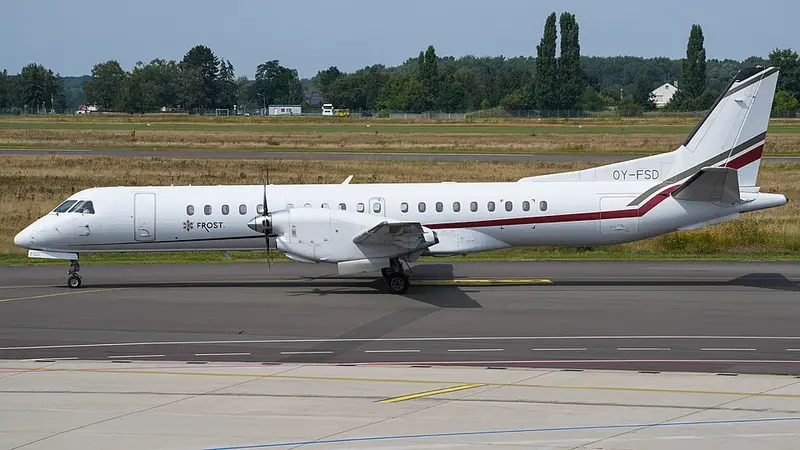
.jpg)
Did you know?
The Saab 2000 was built to cruise nearly as fast as a regional jet, one of the fastest turboprop airliners ever built.
Specifications
| Length | 27 m (89 ft) |
|---|---|
| Wingspan | 24.8 m (81 ft) |
| Height | 7.7 m (25 ft) |
| Maximum passengers | 58 |
| Persons on board | 50-58 |
| Maximum take-off weight | 22.8 t |
| Range | 1,000 NM (1,852 km) |
| Maximum speed | 313 kt (580 km/h) |
| Service ceiling | 31,000 ft (9,449 m) |
| Optimum ceiling | 28,000 ft (8,534 m) |
| Rate of climb | 2,250 ft/min (11.4 m/s) |
| Take-off distance | 1,360 m (4,462 ft) |
| Landing distance | 1,250 m (4,101 ft) |
| Fuel capacity | 5,206 l |
| Engines | 2x Rolls-Royce AE 2100A |
| Units built | 63 |
Curated by CatchFlights from manufacturer documents, ICAO Doc 8643 and reference works; values are left out where no source could confirm them. Sources are listed on our credits page.
In CatchFlights
In CatchFlights the Saab 2000 starts as a Rare catch. The tier is an editorial judgement of how special a sighting of this type is. The more often you catch it, the closer it moves to Common for you.
A catch counts for the manufacturer Saab, the Saab family and the model in your collection, and the daily Type Rating quiz asks about the types of each family.
More from the Saab family
Catch it yourself.CatchFlights shows the aircraft flying near you on a radar, so a type like this one is only a catch away when it passes overhead. Explore CatchFlights.
Browse all aircraft types, or learn to tell Airbus from Boeing.