
Pitts S-2 Special
The Pitts S-2 is the two-seat evolution of Curtis Pitts' single-seat S-1 Special, first flown in 1967 and certified in 1971 specifically so instructors could teach aerobatics rather than send students solo in the demanding single-seater. Aerotek and later Aviat built it in Afton, Wyoming, progressing through the S-2A, S-2B and current S-2C, each retaining the short-coupled biplane layout but growing to a 260-hp Lycoming driving a constant-speed propeller. Its tandem cockpit made it the standard mount for aerobatic instruction and airshow two-seat rides worldwide, spreading the S-1's competition-winning handling to pilots who had never flown an unlimited aerobatic aircraft before.
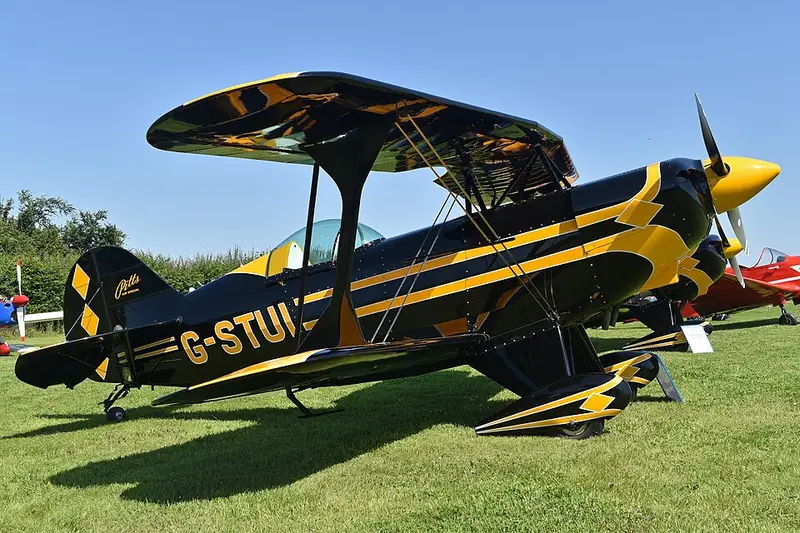
.jpg)
Did you know?
The tandem two-seat answer to teaching aerobatics: built so instructors can coach hands-on instead of watching students struggle solo in the S-1.
Specifications
| Length | 5.7 m (19 ft) |
|---|---|
| Wingspan | 6.1 m (20 ft) |
| Height | 2 m (7 ft) |
| Persons on board | 2 |
| Maximum take-off weight | 0.6 t |
| Range | 270 NM (500 km) |
| Service ceiling | 16,000 ft (4,877 m) |
| Optimum ceiling | 13,000 ft (3,962 m) |
| Rate of climb | 2,500 ft/min (12.7 m/s) |
| Take-off distance | 140 m (459 ft) |
| Landing distance | 150 m (492 ft) |
| Fuel capacity | 110 l |
Curated by CatchFlights from manufacturer documents, ICAO Doc 8643 and reference works; values are left out where no source could confirm them. Sources are listed on our credits page.
In CatchFlights
In CatchFlights the Pitts S-2 Special starts as a Uncommon catch. The tier is an editorial judgement of how special a sighting of this type is. The more often you catch it, the closer it moves to Common for you.
A catch counts for the manufacturer Pitts, the S-2 Special family and the model in your collection, and the daily Type Rating quiz asks about the types of each family.
Catch it yourself.CatchFlights shows the aircraft flying near you on a radar, so a type like this one is only a catch away when it passes overhead. Explore CatchFlights.
Browse all aircraft types, or learn to tell Airbus from Boeing.