
Panavia Tornado
The Panavia Tornado was jointly developed by the United Kingdom, West Germany, and Italy, entering service in 1979 as one of the first successful multinational fighter programs. Its variable-sweep 'swing wings' can angle further back for high-speed, low-altitude flight and forward again for efficient takeoff and landing. Different variants were built for air defence and for low-level strike missions, deliberately designed to fly fast and low to avoid radar detection. After more than four decades of service, it is gradually being retired in favour of newer aircraft like the Eurofighter Typhoon.
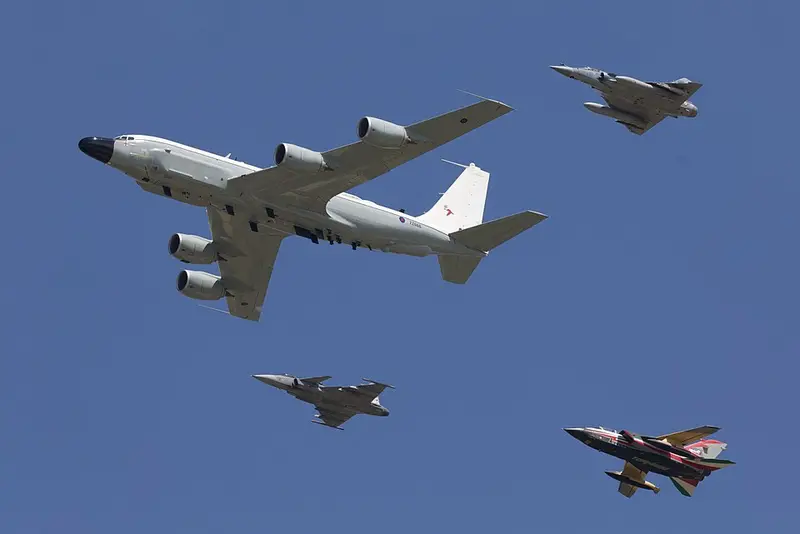
.jpg)
Did you know?
The Panavia Tornado's variable-sweep 'swing wings' angle back for high-speed low flight and forward for efficient takeoff and landing.
Specifications
| Length | 16.7 m (55 ft) |
|---|---|
| Wingspan | 13.9 m (46 ft) |
| Height | 6 m (20 ft) |
| Persons on board | 2 |
| Crew | 2 |
| Maximum take-off weight | 28.1 t |
| Range | 1,400 NM (2,593 km) |
| Maximum speed | 1,320 kt (2,445 km/h) |
| Service ceiling | 50,000 ft (15,240 m) |
| Rate of climb | 15,100 ft/min (76.7 m/s) |
| Take-off distance | 900 m (2,953 ft) |
| Landing distance | 900 m (2,953 ft) |
| Fuel capacity | 5,090 l |
| Engines | 2x Turbo-Union RB199 |
| Units built | 99 |
Curated by CatchFlights from manufacturer documents, ICAO Doc 8643 and reference works; values are left out where no source could confirm them. Sources are listed on our credits page.
In CatchFlights
In CatchFlights the Panavia Tornado starts as a Rare catch. The tier is an editorial judgement of how special a sighting of this type is. The more often you catch it, the closer it moves to Common for you.
A catch counts for the manufacturer Panavia, the Tornado family and the model in your collection, and the daily Type Rating quiz asks about the types of each family.
Catch it yourself.CatchFlights shows the aircraft flying near you on a radar, so a type like this one is only a catch away when it passes overhead. Explore CatchFlights.
Browse all aircraft types, or learn to tell Airbus from Boeing.