
North American AT-28 Trojan
The North American T-28 Trojan was the primary piston-engine trainer for the US Air Force and Navy through the 1950s and 1960s, bridging the gap between older wartime trainers and the jet age with a far more powerful engine and retractable landing gear. Its unusually powerful radial engine for a trainer gave student pilots real experience handling significant horsepower and torque before moving on to jet aircraft. Armed versions saw extensive combat as counter-insurgency attack aircraft in Southeast Asia, a role its rugged airframe and long loiter time suited well. Many surplus T-28s were converted for civilian ownership, and it remains a popular, powerful warbird at airshows today.
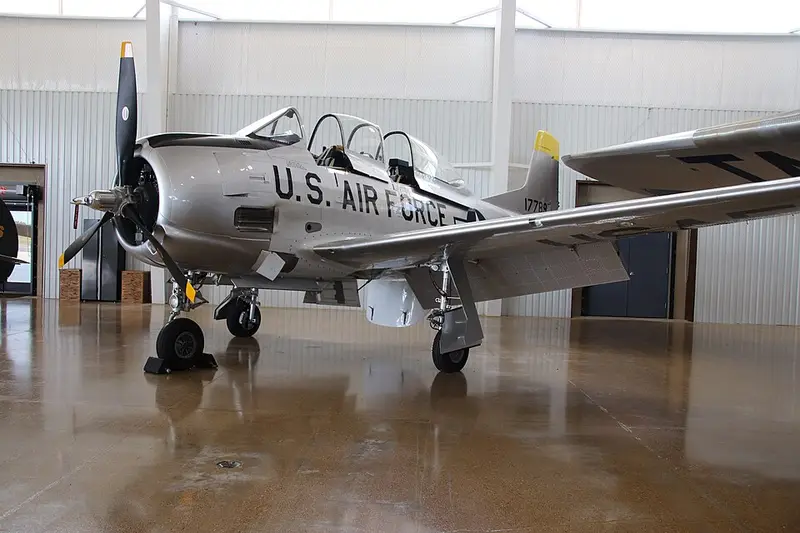
_(48333520322).jpg)
Did you know?
The T-28 Trojan trained a generation of US pilots with an unusually powerful radial engine and retractable gear, bridging piston trainers and the jet age.
Specifications
| Length | 10.1 m (33 ft) |
|---|---|
| Wingspan | 12.2 m (40 ft) |
| Height | 3.9 m (13 ft) |
| Persons on board | 2 |
| Crew | 2 |
| Maximum take-off weight | 7 t |
| Range | 940 NM (1,741 km) |
| Maximum speed | 285 kt (528 km/h) |
| Service ceiling | 24,200 ft (7,376 m) |
| Rate of climb | 2,500 ft/min (12.7 m/s) |
| Take-off distance | 244 m (801 ft) |
| Engines | 1x Wright R-1820 (radial) |
| Units built | 489 |
Curated by CatchFlights from manufacturer documents, ICAO Doc 8643 and reference works; values are left out where no source could confirm them. Sources are listed on our credits page.
In CatchFlights
In CatchFlights the North American AT-28 Trojan starts as a Rare catch. The tier is an editorial judgement of how special a sighting of this type is. The more often you catch it, the closer it moves to Common for you.
A catch counts for the manufacturer North American, the AT-28 Trojan family and the model in your collection, and the daily Type Rating quiz asks about the types of each family.
Catch it yourself.CatchFlights shows the aircraft flying near you on a radar, so a type like this one is only a catch away when it passes overhead. Explore CatchFlights.
Browse all aircraft types, or learn to tell Airbus from Boeing.