
Gloster Gladiator
The Gloster Gladiator was the Royal Air Force's last biplane fighter and its first with an enclosed cockpit, entering service in February 1937 just as monoplane fighters began displacing the type elsewhere. About 747 were built, many going to export customers years before the Spitfire or Hurricane existed. It became famous defending Malta in June 1940, when a handful of Fleet Air Arm Sea Gladiators, later mythologised as 'Faith, Hope and Charity', were briefly the island's entire fighter defence against Italian bombers. Gladiators also fought over Norway, Greece and East Africa before leaving front-line RAF service in 1941.
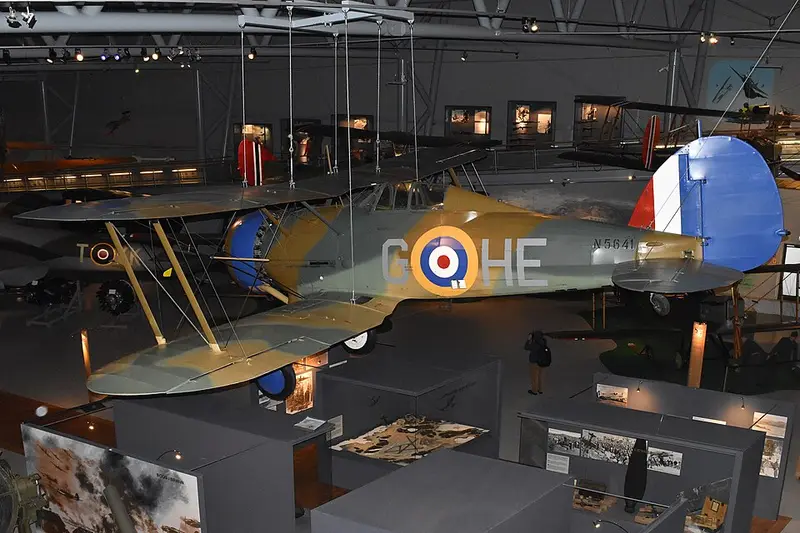
.jpg)
Did you know?
The Royal Air Force's last biplane fighter, and its first with an enclosed cockpit, entering service in 1937 as monoplanes arrived.
Specifications
| Length | 8.3 m (27 ft) |
|---|---|
| Wingspan | 9.8 m (32 ft) |
| Height | 3.5 m (11 ft) |
| Persons on board | 1 |
| Maximum take-off weight | 2.2 t |
| Range | 385 NM (713 km) |
| Service ceiling | 34,000 ft (10,363 m) |
| Optimum ceiling | 13,000 ft (3,962 m) |
| Rate of climb | 2,580 ft/min (13.1 m/s) |
Curated by CatchFlights from manufacturer documents, ICAO Doc 8643 and reference works; values are left out where no source could confirm them. Sources are listed on our credits page.
In CatchFlights
In CatchFlights the Gloster Gladiator starts as a Rare catch. The tier is an editorial judgement of how special a sighting of this type is. The more often you catch it, the closer it moves to Common for you.
A catch counts for the manufacturer Gloster, the Gladiator family and the model in your collection, and the daily Type Rating quiz asks about the types of each family.
Catch it yourself.CatchFlights shows the aircraft flying near you on a radar, so a type like this one is only a catch away when it passes overhead. Explore CatchFlights.
Browse all aircraft types, or learn to tell Airbus from Boeing.