
Douglas DC-6
The Douglas DC-6 was a pressurised evolution of the DC-4, letting it fly higher, above much of the rough weather that shook earlier unpressurised airliners. It became one of the most popular postwar airliners, competing closely with Lockheed's Constellation on the world's premier long-haul routes. Its rugged radial engines and simple systems have kept a surprising number flying today as firefighting tankers and cargo haulers. Few airliner designs from the propeller era have had as long a working life as the DC-6.
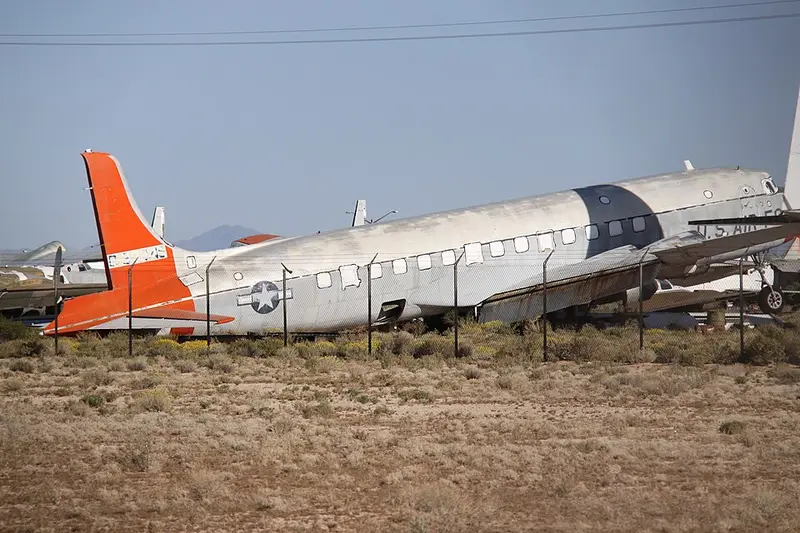
_U.S._Air_Force_(8853704229).jpg)
Did you know?
The DC-6 pressurised the DC-4's airframe to fly above rough weather, and its rugged radial engines still keep many flying today as firefighting air tankers.
Specifications
| Length | 30.7 m (101 ft) |
|---|---|
| Wingspan | 35.8 m (117 ft) |
| Height | 8.7 m (28 ft) |
| Maximum passengers | 102 |
| Persons on board | 48-102 |
| Maximum take-off weight | 48.1 t |
| Range | 2,610 NM (4,834 km) |
| Maximum speed | 245 kt (454 km/h) |
| Service ceiling | 25,000 ft (7,620 m) |
| Optimum ceiling | 18,000 ft (5,486 m) |
| Rate of climb | 1,070 ft/min (5.4 m/s) |
| Fuel capacity | 20,900 l |
| Engines | 4x Pratt & Whitney R-2800 |
| Units built | 704 |
Curated by CatchFlights from manufacturer documents, ICAO Doc 8643 and reference works; values are left out where no source could confirm them. Sources are listed on our credits page.
In CatchFlights
In CatchFlights the Douglas DC-6 starts as a Very rare catch. The tier is an editorial judgement of how special a sighting of this type is. The more often you catch it, the closer it moves to Common for you.
A catch counts for the manufacturer Douglas, the DC-6 family and the model in your collection, and the daily Type Rating quiz asks about the types of each family.
More from the DC-6 family
Catch it yourself.CatchFlights shows the aircraft flying near you on a radar, so a type like this one is only a catch away when it passes overhead. Explore CatchFlights.
Browse all aircraft types, or learn to tell Airbus from Boeing.