
Douglas A-20 Havoc
The Douglas A-20 Havoc was a fast, twin-engine light bomber used extensively by the United States, Britain, and the Soviet Union during the Second World War, valued for being quick enough to outrun many contemporary fighters. The Soviet Union received thousands through Lend-Lease and used it more heavily than any other single operator, employing it for low-level attack, torpedo bombing, and even night fighting. A solid-nose gunship variant, packed with forward-firing machine guns, pioneered ground-attack tactics later refined in aircraft like the A-1 Skyraider and A-10. Comparatively few survive today, making it a rarer warbird sight than more famous WWII bombers.
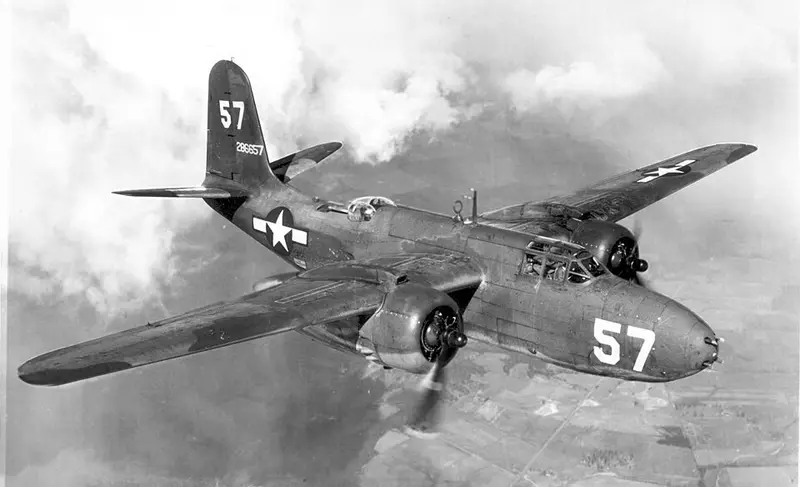

Did you know?
France ordered the Havoc as the DB-7 before the US Army did, so French squadrons flew it into combat first, in May 1940.
Specifications
| Length | 14.6 m (48 ft) |
|---|---|
| Wingspan | 18.7 m (61 ft) |
| Height | 5.4 m (18 ft) |
| Persons on board | 3 |
| Crew | 3 |
| Maximum take-off weight | 12.3 t |
| Range | 950 NM (1,759 km) |
| Maximum speed | 300 kt (556 km/h) |
| Stall speed | 85 kt (157 km/h) |
| Service ceiling | 25,800 ft (7,864 m) |
| Optimum ceiling | 24,000 ft (7,315 m) |
| Rate of climb | 2,000 ft/min (10.2 m/s) |
| Engines | 2x Wright R-2600 (radial) |
| Units built | 7,478 |
Curated by CatchFlights from manufacturer documents, ICAO Doc 8643 and reference works; values are left out where no source could confirm them. Sources are listed on our credits page.
In CatchFlights
In CatchFlights the Douglas A-20 Havoc starts as a Legendary catch. The tier is an editorial judgement of how special a sighting of this type is. The more often you catch it, the closer it moves to Common for you. The first catch of a legendary type pays a bonus of its own.
A catch counts for the manufacturer Douglas, the A-20 Havoc family and the model in your collection, and the daily Type Rating quiz asks about the types of each family.
Catch it yourself.CatchFlights shows the aircraft flying near you on a radar, so a type like this one is only a catch away when it passes overhead. Explore CatchFlights.
Browse all aircraft types, or learn to tell Airbus from Boeing.