
De Havilland DHC-1 Chipmunk
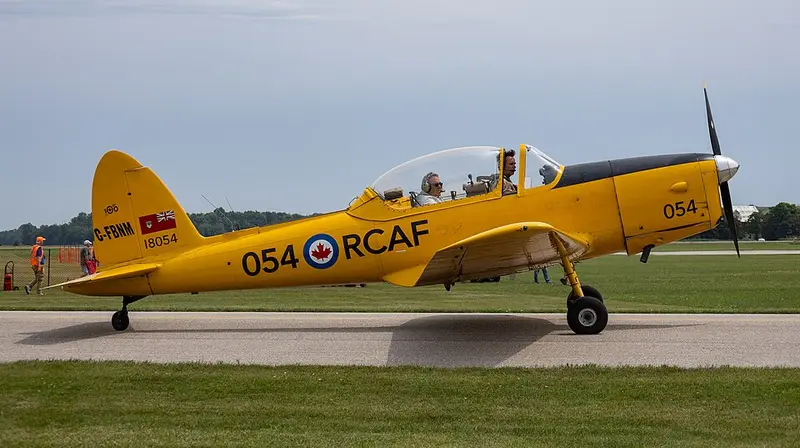
Designed from October 1945 as de Havilland Canada's first postwar project and a direct replacement for the wartime Tiger Moth, the tandem two-seat DHC-1 Chipmunk first flew at Downsview, Ontario on 22 May 1946, only seven months after design work began. Built under licence in Britain and Portugal as well as Canada, it became the standard primary trainer for the RAF, RCAF and other air arms through the 1950s, with production reaching 1,284 aircraft. Unlike the open-cockpit biplane it replaced, the Chipmunk was a low-wing monoplane with an enclosed tandem cockpit, giving trainee pilots their first taste of a more modern aircraft layout. Hundreds remain airworthy in private hands worldwide.
,_Military_Heritage_Day,_Chatham,_Ontario,_2025-06-21_06.jpg)
Did you know?
The Chipmunk replaced the Tiger Moth's open biplane with a low-wing monoplane and tandem enclosed cockpit for primary training.
Specifications
| Length | 7.7 m (25 ft) |
|---|---|
| Wingspan | 10.4 m (34 ft) |
| Height | 2.1 m (7 ft) |
| Persons on board | 2 |
| Maximum take-off weight | 0.9 t |
| Range | 240 NM (444 km) |
| Service ceiling | 17,000 ft (5,182 m) |
| Optimum ceiling | 15,000 ft (4,572 m) |
| Rate of climb | 840 ft/min (4.3 m/s) |
Curated by CatchFlights from manufacturer documents, ICAO Doc 8643 and reference works; values are left out where no source could confirm them. Sources are listed on our credits page.
In CatchFlights
In CatchFlights the De Havilland DHC-1 Chipmunk starts as a Rare catch. The tier is an editorial judgement of how special a sighting of this type is. The more often you catch it, the closer it moves to Common for you.
A catch counts for the manufacturer De Havilland, the DHC-1 Chipmunk family and the model in your collection, and the daily Type Rating quiz asks about the types of each family.
Catch it yourself.CatchFlights shows the aircraft flying near you on a radar, so a type like this one is only a catch away when it passes overhead. Explore CatchFlights.
Browse all aircraft types, or learn to tell Airbus from Boeing.