
De Havilland DH-89 Dragon Rapide
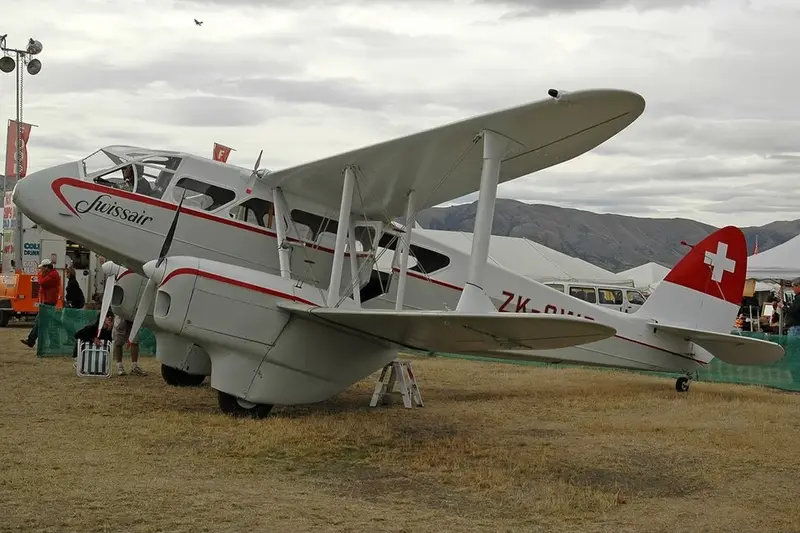
Designed in late 1933 as a faster, more comfortable successor to the DH.84 Dragon, the DH.89 Dragon Rapide first flew at Hatfield on 17 April 1934, effectively scaling down the four-engined DH.86 Express into a twin. Its tapered wings and streamlined fuselage fairings gave it a cleaner look than most biplanes of the era, and its light, strong plywood construction let regional airlines fly it profitably on short domestic routes carrying six to eight passengers. Wartime demand pressed many civilian Rapides into RAF and Royal Navy communications service, and total production reached 727 aircraft by 1946. Several airworthy examples still offer pleasure flights over the English countryside today.

Did you know?
The Rapide is the tapered, streamlined plywood biplane that made short domestic routes profitable for small airlines, and some still fly today.
Specifications
| Length | 10.5 m (34 ft) |
|---|---|
| Wingspan | 14.6 m (48 ft) |
| Height | 3.9 m (13 ft) |
| Persons on board | 8 |
| Maximum take-off weight | 2.3 t |
| Range | 480 NM (889 km) |
| Service ceiling | 19,500 ft (5,944 m) |
| Optimum ceiling | 15,000 ft (4,572 m) |
| Rate of climb | 900 ft/min (4.6 m/s) |
Curated by CatchFlights from manufacturer documents, ICAO Doc 8643 and reference works; values are left out where no source could confirm them. Sources are listed on our credits page.
In CatchFlights
In CatchFlights the De Havilland DH-89 Dragon Rapide starts as a Rare catch. The tier is an editorial judgement of how special a sighting of this type is. The more often you catch it, the closer it moves to Common for you.
A catch counts for the manufacturer De Havilland, the DH-89 Dragon Rapide family and the model in your collection, and the daily Type Rating quiz asks about the types of each family.
Catch it yourself.CatchFlights shows the aircraft flying near you on a radar, so a type like this one is only a catch away when it passes overhead. Explore CatchFlights.
Browse all aircraft types, or learn to tell Airbus from Boeing.