
Cessna 550B Citation Bravo
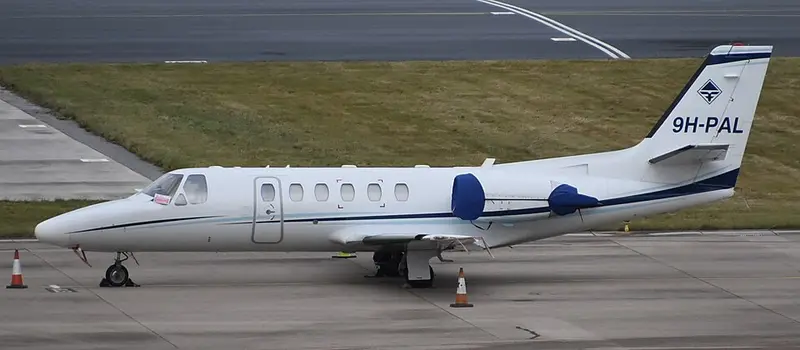
The Cessna Citation Bravo updated the earlier Citation II with more powerful, quieter engines and modern avionics, extending the life of a well-proven light-jet airframe first developed in the 1970s. Its straightforward, relatively simple systems made it popular with small charter operators and flight departments who valued reliability and ease of maintenance over cutting-edge performance. It filled the gap between Cessna's smaller CJ-series jets and its larger midsize Citations for several years. Though newer Citation models have since surpassed it, many Bravos remain in active charter and private service today.
.jpg)
Did you know?
The Bravo replaced the Citation II's Pratt & Whitney JT15D turbofans with newer PW530A engines, its main external giveaway from the II.
Specifications
| Length | 14.8 m (48 ft) |
|---|---|
| Wingspan | 15.9 m (52 ft) |
| Height | 4.6 m (15 ft) |
| Maximum passengers | 8 |
| Persons on board | 8 |
| Maximum take-off weight | 6.8 t |
| Range | 1,875 NM (3,473 km) |
| Maximum speed | 400 kt (741 km/h) |
| Service ceiling | 45,000 ft (13,716 m) |
| Optimum ceiling | 35,000 ft (10,668 m) |
| Rate of climb | 3,040 ft/min (15.4 m/s) |
| Take-off distance | 990 m (3,248 ft) |
| Landing distance | 930 m (3,051 ft) |
| Fuel capacity | 2,330 l |
| Engines | 2x Pratt & Whitney Canada PW530A |
| Units built | 336 |
Curated by CatchFlights from manufacturer documents, ICAO Doc 8643 and reference works; values are left out where no source could confirm them. Sources are listed on our credits page.
In CatchFlights
In CatchFlights the Cessna 550B Citation Bravo starts as a Uncommon catch. The tier is an editorial judgement of how special a sighting of this type is. The more often you catch it, the closer it moves to Common for you.
A catch counts for the manufacturer Cessna, the 550B Citation Bravo family and the model in your collection, and the daily Type Rating quiz asks about the types of each family.
Catch it yourself.CatchFlights shows the aircraft flying near you on a radar, so a type like this one is only a catch away when it passes overhead. Explore CatchFlights.
Browse all aircraft types, or learn to tell Airbus from Boeing.